ionchad's Simple crackme
ionchad's Simple crackme
Entry Point
1
2
3
int64_t main()          // Binary Ninja
void FUN_140001540()    // Ghidra
int __fastcall main()   // Hex-Rays
Static Analysis
The code below displays a message box indicating success or failure based on the value of the flag variable:
1
2
3
4
5
6
7
8
9
10
11
12
if (!flag)
{
    lpCaption = "Error";
    lpText = "Invalid License";
}
else
{
    lpCaption = "Success";
    lpText = "License Accepted!";
}

MessageBoxA(nullptr, lpText, lpCaption, MB_OK);
The variable flag, which is of type bool, is assigned its value in the following section of the code:
1
2
3
4
5
6
if (count != possible_code_size)
    flag = 0;
else if (count)
    flag = !memcmp(possible_input_buffer, buffer2, count); // Core comparsion
else
    flag = 1;
As seen in the code, the variables possible_input_buffer and buffer2 are compared using memcmp() (for readability, the variable names have been renamed).
The code below is responsible for setting the value of possible_input_buffer.
1
int128_t* possible_input_buffer = possible_input_var;
The code below is responsible for setting the value of possible_input_var.
1
int128_t* possible_input_var = sub_140001350(&possible_input_type, &possible_input_char); // Possible input (fgets, gets, etc)
The above function, sub_140001350(), is presumed to be a user input function similar to fgets() or gets(), as it appears to read input from the user.
The code below is responsible for setting the value of buffer2.
1
2
if (var_80 > 0xf)
    buffer2 = moved_code_buffer;
The code below is responsible for setting the value of moved_code_buffer.
1
int128_t* moved_code_buffer = s;
The code below is responsible for setting the value of s.
1
sub_140001220(&s, &possible_code_buffer); // Possible variable data transfer (&possible_code_buffer -> &s)
The above function, sub_140001220(), is presumed to be a variable transfer function, as it appears to move the data inside the variable possible_code_buffer to s.
The code below is responsible for setting the value of possible_code_buffer.
1
strncpy(&possible_code_buffer, "KIWZ", 5);
Therefore, the expected program flag is as follows: KIWZ
Dynamic Analysis
As expected, the program operates by prompting the user to enter a license, as shown below:
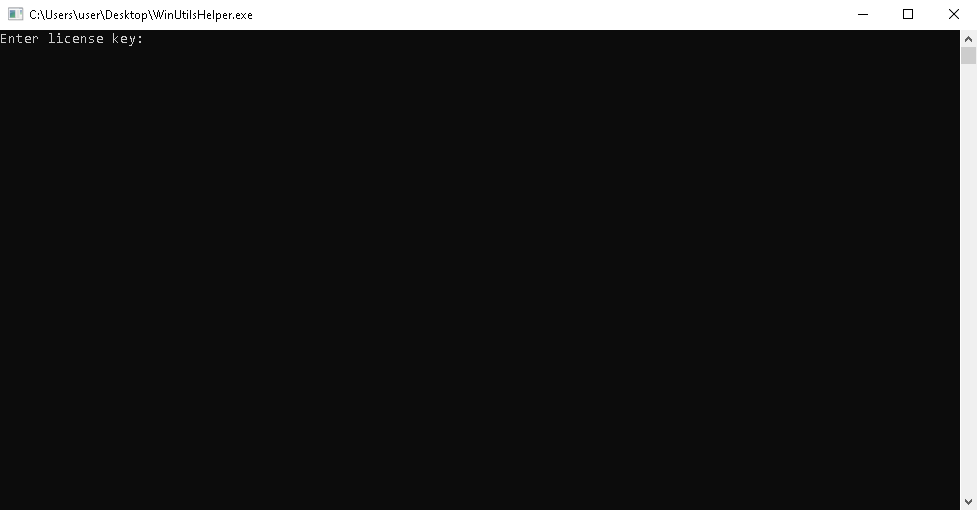
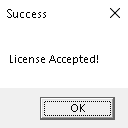
After entering KIWZ, a message box appeared confirming that the license was successfully accepted, as shown below.
Flag
Therefore, the final flag of this program is as follows: KIWZ